
Question:
The query I have received is somewhat more challenging than the title of this article; it simply says: “Is watching television a sin?” Clearly, one must answer: “It depends…” A well‑known fable by Aesop ends with the moral that the tongue can be both the best and the worst thing. In fact, we can use it either to pray to God or to curse our neighbor. Something similar can be said about television: it can be something good, something excellent, or something very bad, because it is merely an instrument, and instruments depend on those who use them. I will not analyze the moral guidelines that should govern those who make television programs, but rather those who watch television. And I must hasten to say that we are touching on a truly serious problem, before which the vast majority of men and women seem deaf and blind, or if not, they at least give the impression of having given up in a struggle where very fundamental values are at stake (and in danger).
Answer:
If it cannot be said as a principle that watching television is a sin, we can then ask: Is it a sin in some cases? Certainly! And in many cases! When? For example:
- When one watches things that are in themselves evil, sin takes its species from the moral object that one consents to or delights in. By fully consenting to see certain images or by fully accepting certain statements, one may sin (at least internally) by impurity, adultery, violence, slander, defamation, etc. We must not forget that sinful glances, thoughts, and desires, when fully consented to, are sin, and they can be mortal sin, and in many cases, they are.
- Something similar should be said of those things that are not entirely evil but are watched with evil intentions. Something need not be completely evil, for the imagination can be far more disordered than reality itself.
- When one watches stupid things (if habitual), one may sin through foolishness. In the order of nutrition, we assimilate into our bodies what we eat; in the spiritual and cultural order, it can be said that we become like what we receive. “You love heaven: you are heaven; you love mud: you are mud” – this is from Saint Augustine. As for our topic: do we like and receive into our intellect frivolous, worldly, insubstantial images, news, reasoning, slogans, etc.? Well then, we become such things and sin by frivolity, worldliness, shallowness, and fatuity. Television can swallow us up into its hollow spirit.
- When one wastes too much time in front of the television, one sins by sloth, by wasting time; and we become responsible for the consequences this brings upon ourselves or upon those over whom we do not exercise due control, because exposure to television for an excessive time disturbs the mind and imagination, atrophies affective life (creating unsociable, lonely, isolated persons, violent or sexually deformed individuals, etc.).
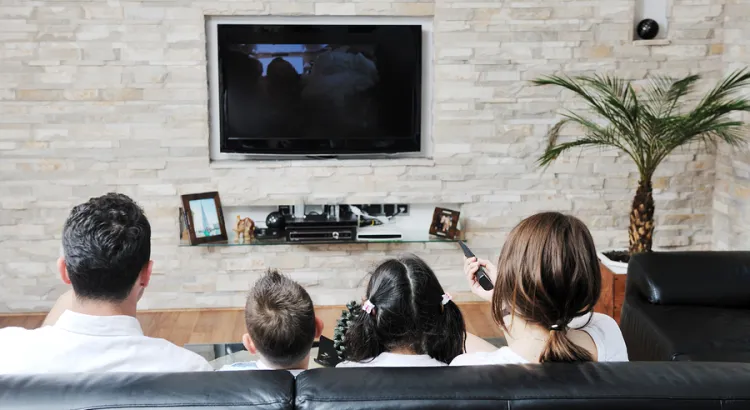
- When one delegates to television the functions of ‘educator’ of one’s children, or, worse yet, of ‘father/mother’ of the children, making television an ‘electronic babysitter’ – one sins by grave negligence in the duties of one’s state in life (I am thinking of fathers, mothers, educators, etc.). The consequences are sometimes disastrous. One should recall what important analysts of the phenomenon have said, for example, Giovanni Sartori, author of Homo videns: “Those who make television are illiterate”; and on another occasion: “Television produces images and annihilates concepts, and in this way it atrophies our capacity for abstraction and all our capacity to understand.” The famous filmmaker Constantin Costa‑Gavras, for his part, has said that television is characterized by vulgarity. “The worst sin of television: vulgarity… We end up resembling what we watch. The more vulgarity there is on TV, the more vulgar we all become.”
- When one neglects more important obligations, such as commitments, work, study, etc., one sins by upsetting the order of things and against the duties of one’s state or professional obligations.
- When one asks television to fill the inner void that only God and spiritual values can fill, one may sin to some extent by idolatry, at least by a certain surreptitious or underhanded “idolatry.” I do not think anyone prays to television or deifies it, but neither can it be denied that in many cases people seek in it values that are directly related to God: happiness, the meaning of life, etc. One must also recognize that for many, television has replaced such elementary human things as prayer, reading, meditation on the great truths, study, play, conversation, friendship, family life (or at least it leaves no room for these things).
- When one watches without criteria and without discernment, one sins by becoming responsible for the errors one assimilates. The percentage of television news that suffers from a lack of seriousness, balance, and prudence is quite notable; on the contrary, it overflows with sensationalism, and in many cases, it is characterized by irresponsible falsehood, exaggeration, and adulteration. Certain types of journalism that are very widespread today can easily fall into slander, defamation, and violation of the family privacy of others, with all the destructive social consequences that this entails. Whoever accepts journalistic “inside information” without a highly critical spirit may become an accomplice to it, or fall into gossip, vain curiosity, and verbiage.
Statements as serious as these certainly require that we provide some foundation for them. Let us say that television, when kept within measure (measured in its object, ends, circumstances – such as time, place, company, etc.), can fulfill notable functions: educational, informative, recreational, and evangelizing. This cannot be denied, and would that it were always used that way. But unfortunately, many times it not only fails to fulfill these functions but has become a serious threat.
Allow me to offer here a series of data, perhaps somewhat disorganized, but which ground the moral judgments I have made above.
A study conducted at the beginning of the 1980s in our country already concluded that while children with good family bonds seek primarily entertainment and information from television, children with family and group deficiencies use television as a compensatory mechanism for these deficiencies. This compensation occurs through a projection or transfer by which children identify with characters that respond to the characteristics of their personal problems, and whom they take as models or archetypes.
Let us turn to the results of more recent studies and surveys:
- The exposure time of Argentine children averages 4 hours and 20 minutes of television per day. Thus, by age 16, an adolescent has devoted 46,620 hours to sleeping, 22,464 hours to watching television, and 13,440 hours to school. International studies have determined that by the time a student finishes high school, he has spent at least about 11,000 hours at school, compared to about 15,000 hours in front of a television set and about 10,500 hours listening to music.
- In those 22,464 hours that the adolescent has watched by age 16, he has witnessed 150,508 violent acts, 17,520 homicides, and 250,000 television commercials. Another source reports that in Argentina, with an average of 4 hours of television watched per day, a child spends approximately 1,460 hours per year (i.e., 60 full days). As for content, 25 scenes of violence appear per hour within the children’s programming block.
- For some scholars, current television can certainly be granted favorable aspects (it helps broaden one’s view of the world; it is a means of cultural diffusion; it is the most influential communication medium; it is an excellent medium for non‑formal education; it can serve for the political education of citizens), but also unfavorable aspects (it tends to lower academic performance; it reduces time devoted to reading; it diminishes the importance and time for family dialogue; it stimulates mental laziness and boredom; it instills false values; it fosters consumerism; it works against outdoor life).
- Nearly 500,000 children between the ages of 6 and 12 watch television in Buenos Aires after 10:00 p.m., outside the minor protection hours; of these, about 250,000 stay up until midnight. A large portion of the programs they consume contains sexual and pornographic content.
- A survey conducted by sociologist Tatiana Merlo in the Federal Capital of 420 parents, 60 television producers, and 184 children from 15 schools of different levels yielded the following results:
- In the children’s opinion, the model television family is “The Simpsons”; the foreign character with whom they most identify is Goku, the star of “Dragon Ball Z” (75% of the children), and among Argentine characters, two characters from the series “Chiquititas.”
- In the parents’ opinion regarding who has the most influence on their children’s behavior, 46% of the parents surveyed answered that it is the parents themselves; for 32%, it is television; for 6%, it is musical idols; and only for 3%, it is teachers.
- As for the reason why children watch television, 50% answered that they watch for entertainment or out of addiction; 12% said they have something to talk about; 11% thought that the reason is that parents encourage them; 6% said they watch to avoid thinking; and only 5% answered that they watch to learn.
- In the U.S., at least two out of every three prime‑time television programs contain violence. 67% of broadcast networks present violent programs, compared to 77% of independent stations, and 64% of basic cable television services. Premium cable television service tends to have almost exclusively violent programming, with percentages as high as 98%. Karen McLaughlin, Director of the National Center for Hate Crime Prevention (which depends on the U.S. Departments of Justice and Education), advisor to the U.S. president on school crime prevention, has maintained (during a visit to Argentina) that television increases aggressiveness, in general and especially in children and adolescents. She explains that “a child sees 1,000 homicides a year on television. By the time he reaches 18, he has 18,000 crimes in his mind. Attacks become normal on television, and the suffering of the victims or the possibility of going to prison are set aside.” It should not be surprising that in the United States, during 1997, according to the same source, 6,000 children and adolescents had to be expelled from their schools for having brought weapons to school.
- On weekends (Saturday and Sunday), violent scenes increase by 100% to 150%. The presence of children in front of the television also increases during that time.
Unfortunately, the greatest concern of parents, pedagogues, teachers, and pollsters seems to be largely limited to the violent content of television. But no less serious is the sexual content with which television bombards its viewers, for example:
- Content that promotes atrophied affectivity (childish courtships, dangerous friendships, kisses, touching, evil desires) – which make up the almost exclusive theme of soap operas and tasteless melodramas aimed not only at a female audience but also at adolescents and even children (a particular survey, conducted in May 1999, sampling 200 young people from a 7th and an 8th grade of a good public coeducational school, and an 8th and three 9th grades of a private coeducational school, showed that 95% of respondents watch soap operas);
- Anti‑marriage and anti‑family content, promoting “living as a couple” (i.e., cohabitation instead of validly constituted marriage), love triangles, divorces and separations, reconciliations, adulteries, and infidelities (a study from this year, based on three main channels in Argentina, revealed that on these channels alone, seventy hours per week of soap operas and comedic dramas are broadcast, during which no fewer than thirty‑eight infidelities occur, i.e., about forty adulteries per week);
- Explicit sexual content, not only on coded channels but also on cable and over‑the‑air television, at all hours and for all audiences;
- Ideological content that, on many panel programs, interviews, lunchtime shows, informal chats, etc., presents as normal, praises, excuses, and even promotes deviant, unnatural sexual behaviors, and in some cases linked to psychopathologies, such as transvestism, homosexuality, transsexualism, lesbianism, voyeurism (and in some countries also pederasty and sexual violence); And so on.
The Responsibility of Parents
We must recognize that the education of children is often offloaded onto television; it entertains children and young people, leaving adults undisturbed – no shouting, no noise, no conversations that parents often do not know how to conduct. That is why Pope John Paul II, in a 1994 Message, said that “Parents who make regular, prolonged use of television as a kind of electronic babysitter surrender their role as the primary educators of their children.”
The Pope does not deny the positive aspects of television: It can, he says, “enrich family life. It can unite members more closely… It can increase not only their general knowledge but also their religious knowledge, facilitating listening to the word of God…” But we must not be blind to its negative aspects; therefore he continues: “Television can also harm family life: by disseminating false and degrading values and models of behavior, by broadcasting pornography and brutal images of violence; by instilling moral relativism and religious skepticism; by presenting distorted relationships, manipulated reports of current events and issues; by transmitting advertising that exploits and appeals to base instincts and exalts a false vision of life… Even when television programs are not morally objectionable, television can have negative effects on the family. It can contribute to the isolation of family members in their own worlds…; it can divide the family, distancing parents from children and children from parents.” A tragicomic example of the negative effects on family life comes from the “family education plan for orangutans” tried at the St. Petersburg Zoo in Russia. The authorities wanted to stimulate family bonds between a pair of orangutans using television. The news is suggestive: “The keepers placed a television set outside the cage where the orangutans Monika and Rabu live, so that the animals could watch videos with documentaries showing them how to be ‘good parents.’ The goal was to ‘educate’ the primates so that they, in turn, could educate their offspring. Monika and Rabu received the video course after the birth of their baby, Ramón, in November. Since then, both orangutans began to be even more negligent in raising the baby, paying it almost no attention. The male has grown fat, as he spends his days sitting in front of the set. Since he discovered television, Rabu ignores Monika completely (and she is no less seduced by television than the male). Ivan Korneyev, the zoo director, told the newspaper The Moscow Times that, in view of the changes that occurred in the orangutans’ relationship, the authorities are thinking of reducing the time they are allowed to watch television, even though it makes them nervous; ‘We want to reduce television time so that the family can have an opportunity to get back together,’ he said. He was referring to the monkeys.” And for the human race, how are we doing?
That is why the Pope indicates some criteria for parents to educate their children – and with their children – about “knowing how to watch television”:
- Inform children in advance about the content of programs.
- Make a conscientious selection according to the good that a given program will bring to the family (the good that follows from watching or from not watching).
- Discuss (dialogue about) television with children, putting them in a position to regulate the quantity and quality of programs and to recognize and judge the ethical values underlying certain programs.
- Know how to turn off the television when there is something better to do, whether it be talking with parents and siblings, playing, or simply when indiscriminate viewing might be harmful.
One must avoid seeking on television a kind of “psychotherapy for loneliness.” Last year (1998), some Argentine newspapers reported the case of Wolfgang D. (they did not even give his surname), another victim of the loneliness of big cities. Like many other men of our time, he too experienced the harmful effects of a family in which his father, getting drunk, then became violent with his son; he too, like many others, formed a family in which he did not bother to have children, and which he did not try to save amidst natural difficulties and misunderstandings; he too ended up separated and alone, sick, alcoholic, and depressed. He too cut himself off from the world and sought to fill the emptiness of his days with the constant flickering of the television. They found him in 1998, when the building owner forced open the door of his apartment, which he believed had been abandoned for some time. He had died in 1993; his skeleton remained seated in his chair, in his hands the magazine with the television schedule, open to December 5, 1993; before him was only a television set that at some point during those five years had suffered a breakdown and stopped working. For five years, his body lay alone, watched over by that anonymous and indifferent screen.
In short, we should not be afraid to watch a little and measured television. Some may think it exaggerated to hear that the less television one watches, the better, but at least they should accept that the opposite is a great truth: the more television one watches, the worse it is (worse for education, worse for family life, worse for the psychological and affective balance of the person). On this point, I am convinced that one should not abuse even good and educational programs, nor those with religious and formative content. That too is good if used in a measured and prudent way.
We must use television as a valuable instrument in the building up of the person, but not allow ourselves to be used by it in the work (intentional or not) of destroying society, the family, and our souls.
Fr. Miguel A. Fuentes, IVE
Original Post: Here