Question:
Father: Did Adam really exist or is he an allegory? How should we interpret the texts of Genesis?
Answer:
ETYMOLOGY AND USE OF THE WORD
There is a divergence of opinion among Semitic language experts when attempting to explain the meaning of the Hebrew word Adam (which most likely was originally used as a common noun and not a proper name), and no theory has been entirely satisfactory so far. This uncertainty stems from the fact that the root of the word Adam, meaning ‘man’ or ‘humanity,’ is not common across all Semitic languages, although the name is, of course, used in Old Testament translations. With this original meaning, it is only found in Phoenician and Sabean, and probably also in Assyrian. In Genesis 2:7, the name seems to be related to the word a-Adánah (‘the earth’), in which case the term’s value would be that it represents man (ratione materiæ) as born from the earth, similar to Latin, where the word homo is supposed to come from humus.(successively: from rational matter, to man, and to earth. Translator’s Note). It is a generally recognized fact that the etymologies proposed for the narratives in the Book of Genesis are often divergent and not always philologically correct, and although the theory (based on Genesis 2:7) linking Adam with Adanah is defended by some specialists, this interpretation is now discredited. Others explain the term with the meaning of ‘to be red,’ a meaning rooted in various passages of the Old Testament (e.g., Genesis 25:50), as in Arabic and Ethiopic. In this hypothesis, the name seems to have been used originally indifferently for the red race or red color. In this sense, Gesenius comments that in ancient Egyptian monuments, human figures representing Egyptians are constantly painted red, while those representing other races are black or some other color. Something analogous to this explanation is deduced from the Assyrian expression çalmât qaqqadi, ‘black heads,’ which is often used to denote men in general. Some writers combine this explanation with the preceding one and assign to the word Adam the double meaning of ‘red earth,’ thus adding to the notion of the material from which man originates the note of the color of the earth from which he was formed. A third theory, which currently seems to be the prevailing one, explains the root Adam with the meaning ‘to make,’ ‘to produce,’ connecting it with the Assyrian Adanu, whose probable meaning is ‘to build,’ ‘to erect’; hence Adam would mean ‘man’ in the passive sense, as made, built, created, or in the active sense, as a laborer.
In the Old Testament, the word is used both as a common noun and a proper name, and in the first sense, it has different meanings. Thus, in Genesis 2:5, it is used to denote a human being, man or woman; less frequently, as in Genesis 2:22, it means man as opposed to woman; and finally, it sometimes denotes humanity as a whole, as in Genesis 2:26. The use of the term, both as a common noun and a proper name, is shared by the sources identified in critical circles as P and J. Thus, in the first creation narrative (P), the word is used in reference to the creation of humanity, of both sexes, but in Genesis 5:14, a text from the same source, it is used as a proper name. Similarly, in the second creation account (J), it speaks of ‘the man’ (ha-Adan), but later (Genesis 4:25) the same document uses it as a proper name without the article.
ADAM IN THE OLD TESTAMENT
All the information in the Old Testament about Adam and the beginning of the human race is contained in the first chapters of Genesis. To what extent these chapters should be considered strictly historical is a topic of intense debate, which is beyond the scope of this article. However, it is striking that the story of Creation is told twice, in the first chapter and the second, and although there is substantial agreement between the two accounts, there is nevertheless considerable divergence in the setting and details. It is usual for writers reluctant to recognize the presence of independent sources or documents in the Pentateuch to explain this double narrative by saying that the writer, having differentiated the successive phases of Creation in the first chapter, returns to the subject in the second to add some more extensive details, especially regarding the origin of man. However, very few scholars today, even Catholics, are satisfied with this explanation, and among critics of any school, there is a very strong opinion that we are in the presence of a rather common phenomenon in Oriental historical accounts: the combination or juxtaposition of two or more independent documents joined more closely by the writer—the Semitic historian being essentially a compiler. (See Guidi, L’historiographie chez les Sémites in the Revue Biblique, October, 1906.) The reasons for this viewpoint, as well as the opposing arguments, can be found in Dr. Gigot’s work, Special Introduction to the Study of the Old Testament, Pt. I. Suffice it to say that a similar repetition of the main events narrated is clearly visible throughout all the historical parts of the Pentateuch, and even in later books like Samuel and Kings, and that the conclusion drawn from this phenomenon is confirmed not only by the different styles and characteristic viewpoints of the double narratives but also by the divergences and antinomies they typically exhibit. Whatever the case, it is pertinent to the purpose of this article to examine the main features of the double creation narrative with special reference to the origin of man.
In the first account (Genesis 1; 2:4a), Elohim is presented as creating different kinds of beings on successive days. The plant kingdom is created on the third day; the sun and moon are placed in the firmament on the fourth; on the fifth day, God creates the living creatures of the water and the birds of the sky, which receive a special blessing and the command to be fruitful and multiply. On the sixth day, Elohim creates, first, all the living creatures and beasts of the earth; and then, in the words of the sacred text:
“Then God said: ‘Let us make man in our image, after our likeness. Let them have dominion over the fish of the sea, the birds of the air, and the cattle, and over all the wild animals and all the creatures that crawl on the ground.’ God created man in his image; in the divine image he created him; male and female he created them.”
Then follows the blessing along with the command to increase and fill the earth, and finally, the plant kingdom is assigned to them for food. Considered in isolation, this Creation narrative leaves room for doubt as to whether the word Adam, ‘man,’ used here is understood by the writer to designate the individual or the species.
There are some indications favorable to the latter, e.g., in the context, the previously mentioned creations undoubtedly refer to the creation of immense numbers of individuals belonging to the various species, and not to the creation of a single individual or pair. For man, one might reach the same conclusion from the expression, ‘male and female he created them.’ However, in another passage (Genesis 5:15), which belongs to the same source as the first account—where the information of the previous narrative is repeated and partly supplemented—it dares to give its interpretation. This passage contains the genealogical reference of the so-called Priestly document to Adam; here we read that God
“created them male and female. When they were created, he blessed them and named them “man.”
And the writer continues:
“Adam was one hundred and thirty years old when he begot a son in his likeness, after his image; and he named him Seth. Adam lived eight hundred years after the birth of Seth, and he had other sons and daughters.The whole lifetime of Adam was nine hundred and thirty years; then he died.”
Here, evidently, the Adam or man of the Creation account is identified with a particular individual, and consequently, the plural forms that might cause doubt elsewhere are understood as referring to the first pair of human beings.
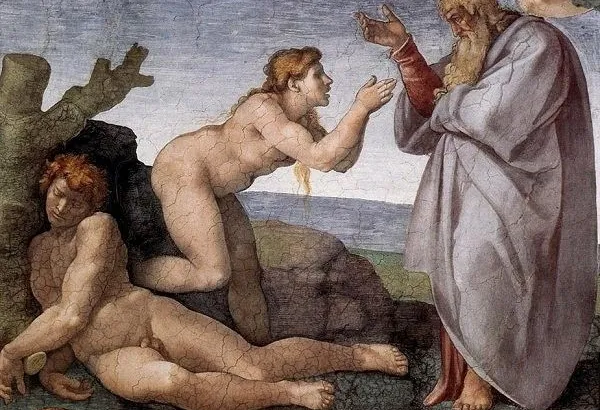
In Genesis 2:4b-25, we find what appears to be a new and independent account of Creation, not a simple expansion of the narrative already given. It does not seem to presuppose anything previously related. In fact, the writer goes back to a time when there was neither rain, plant, nor beast of the field; and, while the earth was still a lifeless waste, man is formed from the dust by Yahweh, who makes him live by breathing into his nostrils the breath of life. Whether these texts should be interpreted literally or figuratively, and whether the creation of the first man was direct or indirect, see GENESIS, CREATION, MAN. Here, the creation of man, instead of occupying the last place, occupies the first position in ascending order, placed before the creation of plants and animals, and the latter are recounted as having been created afterward to meet the needs of man. Man is not commanded to dominate the whole earth, as in the first account, but is charged with caring for the Garden of Eden with permission to eat its fruit, except from the tree of the knowledge of good and evil. The creation of woman is narrated as a later idea of Yahweh, to help man, after recognizing man’s inability to find suitable companionship in the original creation. In the previous account, after each step, ‘God saw that it was good,’ but here Yahweh sees that it is not good for man to be alone and proceeds to remedy the deficiency by forming the woman Eve from the man’s rib while he is in a deep sleep. According to the same narrative, they live in childlike innocence until Eve is tempted by the serpent, and the two eat the forbidden fruit. Then they become aware of their sin, provoke Yahweh’s displeasure, and lest they eat from the tree of life and thus become immortal, they are cast out of the Garden of Eden. Henceforth, their lot is pain and toil, and man is condemned to the arduous task of earning his sustenance from a land that, because of his fault, has been made barren. The same document gives us some details about our first parents after the Fall: the birth of Cain and Abel the fratricide, and the birth of Seth. The other version, which seems unaware of Cain or Abel, mentions Seth as if he were the firstborn (Genesis 5:3) and adds that during the eight hundred years following Seth’s birth, Adam begot sons and daughters.
Despite the differences and notable discrepancies between the two versions of the origin of humanity, the accounts agree in substance, and the opinion of most experts is that they can be reconciled and easily explained if they are considered as representing two variants of Hebrew traditions—traditions that include the same central historical facts differently, along with a more or less symbolic presentation of certain moral and religious truths. Thus, in both accounts, man is clearly the favorite, dependent on God the Creator; yet he enters into direct contact with Him through the creative act, excluding any other intermediary being or demigods as found in other mythologies. This man, more than all other creatures, shares the perfection that God manifests in the first account, where he is created in the image of God, and corresponds in the other account because man receives life from the breath of Yahweh. On the other hand, man has something in common with animals, implied by his creation on the same day and also by the ineffective effort to find a suitable companion among them. He is the master and crown of creation, as clearly related in the first version, where the creation of man is the climax of God’s works, and where his supremacy is explicitly declared, and which is just as clearly implied in the second narrative. Although his importance is highlighted because the creation of man is placed before that of animals and plants, the subsequent creation of animals and plants would be simply for his use and benefit. The woman appears as secondary and subordinate to man, though identical to him in nature, and the creation of one woman for one man implies the doctrine of monogamy. Furthermore, man is created innocent and good; sin came to him from outside and was followed by a severe punishment that not only affected the guilty pair but their descendants and other beings as well. Therefore, the two narratives are practically one regarding their didactic and illustrative purpose, and it is undoubted that we must consider this characteristic of primary importance. It is very necessary to note in passing the height of the doctrinal and ethical truths of the biblical narrative, which is far above the extravagant creation stories narrated among the pagan peoples of antiquity, although some, particularly the Babylonian, have a more or less striking resemblance in form. In light of their doctrinal and moral excellence, the problem of the strict historical character of the narrative, both in structure and details, becomes less important, especially when we remember that in history as understood by other biblical experts, as well as experts in Semitic writings, the presentation and order of facts are habitually—even primarily—subordinated to the demands of didactic concern.
Regarding extra-biblical sources that shed light on the Old Testament narrative, it is well known that the Hebrew account of Creation finds a parallel in the Babylonian tradition as revealed by cuneiform writings. It is beyond the scope of this article to discuss the historical dependency relationships that may exist between the two cosmogonies. Suffice it to say that in the ‘Creation Epic,’ concerning the origin of man, the fragment supposed to contain it has not been found. However, there are good reasons for independent scholars to assume that it originally belonged to the tradition included in the poem and that it must have occupied the final place, after the account of the creation of plants and animals, as in the first chapter of Genesis. Among the reasons for this hypothesis are:
- The divine warnings are addressed to men after their creation, towards the end of the poem;
- The account of Berosus mentions the creation of man by one of the gods, who mixed clay with the blood that flowed from the severed head of Tiamat;
- A non-Semitic (or pre-Semitic) account translated by Pinches from a bilingual text, in which Marduk is said to have made humanity with the cooperation of the goddess Aruru.
As for the creation of Eve, no parallel has been discovered so far among the fragmentary records of the Babylonian creation story. The account, as it appears in Genesis, should not be taken literally as descriptive of a historical fact, according to the opinion of Origen, Cajetan, and also defended now by scholars such as Hoberg and von Hummelauer. These and other writers see in this narrative an account of a symbolic vision of the future, analogous to Abraham’s dream (Genesis 15:12) and that of St. Peter in Joppa (Acts 10:10 ff.). (See Gigot, Special Introduction to the Study of the Old Testament, pt. I, p. 165 ff.)
Later, in the books of the Old Testament, there are very few references to Adam as an individual, and they add nothing to the information contained in Genesis. Thus, his name, without comment, appears at the head of the genealogies in the First Book of Chronicles; it is similarly mentioned in Tobit 8:8; Hosea 6:7; etc. The Hebrew word Adam appears in other passages but in the sense of man or humanity. The mention of Adam in Zechariah 13:5, according to the Douay and Vulgate versions, is due to a mistranslation of the original.
ADAM IN THE NEW TESTAMENT
References to Adam in the New Testament as a historical character occur in only a few passages.In the third chapter of Luke’s Gospel, the Savior’s genealogy is traced back to ‘Adam, the son of God.’ This extension of Jesus’s earthly lineage beyond Abraham, unlike the Gospel of Matthew, is doubtless due to a more universalist spirit and the characteristic predilection of our third evangelist, who writes for the instruction of Gentile catechumens of Christendom and not so much from the viewpoint of Jewish prophecy and hope. Another mention of the historical father of the species is found in the Epistle of Jude (verse 14), where a quotation is made from the apocryphal Book of Enoch, the antediluvian patriarch, citing, ‘Enoch, the seventh from Adam.’ But the most important references to Adam are found in the Epistles of St. Paul. Thus, in 1 Timothy 2:11-14, the Apostle, after establishing certain practical rules concerning the conduct of women, particularly regarding adornment, and inculcating the duty of subordination to the other sex, bases the strength of his arguments more on the mindset of the time than on their intrinsic value as modern mentality would judge today. He says: “For Adam was formed first, then Eve. Further, Adam was not deceived, but the woman was deceived and transgressed.”
A similar line of argument is followed in 1 Corinthians 11:8-9. More important is the theological doctrine formulated by St. Paul in the Epistle to the Romans, 5:12-20, and in 1 Corinthians 15:22-45. In the latter passage, Jesus Christ is called by analogy and contrasts the new and ‘last Adam.’ This must be understood in the sense that as the original Adam was the head of all humanity, the father of all according to the flesh, so also Jesus Christ is constituted the principle and head of the spiritual family of the elect, and potentially of all humanity, since all are invited to share in his salvation. Thus, the first Adam is a type of the second, but while the former transmits to his descendants a legacy of death, the latter, on the contrary, becomes the life-giving principle of restoration. Christ is the ‘last Adam’ because “There is no salvation through anyone else, nor is there any other name under heaven given to the human race by which we are to be saved”(Acts 4:12); no other head or father of the race is to be expected. The first and the second Adam occupy the position of head with respect to humanity, but whereas through the disobedience of the first, he and the whole race were tainted, leaving his posterity an inheritance of death, sin, and misery, the other, through his obedience, gains for all those who become his disciples a new life of holiness and the eternal reward. It can be said that the contrast thus formulated expresses the fundamental principle of the Christian religion and contains the core of the very doctrine of the economy of salvation. It is mainly in these and other passages of similar importance (e.g., Matthew 18:11) that the fundamental doctrine is based: our first parents were created by the Creator in an original state of innocence, and the restoration of this was the object of the Incarnation. It is hardly necessary to say that the fact of this restoration is not clearly deduced from the isolated account of the Old Testament.
ADAM IN JEWISH AND CHRISTIAN TRADITION
It is a well-known fact that to the overly concise biblical narratives, details have been added, partly from a desire to satisfy pious curiosity and partly to emphasize ethical teaching. Later Jewish, early Christian, and Mohammedan tradition gathered an exuberant harvest of legendary lore around the names of all the important characters of the Old Testament. It was therefore natural that the story of Adam and Eve should receive special attention and consequently be developed by this process of embellishment. These additions, some of them extravagant and puerile, are chiefly imaginary, and at best are based on a novelized interpretation of some small detail of the sacred narrative. It is unnecessary to say that these accounts contain no real historical information, and their main utility is to provide an example of the pious popular belief of the time, as well as to add some value to the aforementioned Jewish traditions when invoked as an argument in critical analysis. There are many rabbinic legends speaking of our first parents in the Talmud, and many are collected in the apocryphal Book of Adam, now lost, but from which some extracts have come down to us in other works of a similar nature. The most important of these legends, which is beyond the scope of this article, can be found in the Jewish Encyclopedia, I, art. ‘Adam,’ and concerning Christian legends, in Smith and Wace, Dictionary of Christian Biography.
For New Testament references, see the commentaries by PALIS in VIG., Dict. de la Biblia, s.v.; BENNETT and ADENEY in HAST., Dict. of the Bible, s.v.; For the Old Testament, GIGOT, Special Introduction to the Study of the Old Testament, I, 4; VON HUMMELAUER, Comm. on Genesis.
JAMES F. DRISCOLL
Translated by Félix Carbo Alonso
The Catholic Encyclopedia, Volume I
Copyright (c) 1907 by Robert Appleton Company
Online Edition Copyright (c) 1999 by Kevin Knight
La Enciclopedia Católica Copyright (c) 2000 ACI-PRENSA
Nihil Obstat, March 1, 1907. Remy Lafort, S.T.D., Censor
Imprimatur +John Cardinal Farley, Archbishop of New York
Original Post: Here