Question:
Two similar inquiries have arrived.
- Many people say the following: ‘Why doesn’t the Vatican sell all its riches in buildings and works of art to feed the poor?’ What is the answer to this popular accusation? Thank you.
- How can one respond with full foundation and certainty to comments about the riches of the Vatican?
Answer:
This is an old criticism that many sects launch against the Catholic Church. The answer must be given in several points.
1. One cannot compare the economic needs of the Church in our times with the economic needs of the small group of apostles gathered around Jesus. Some engage in dialectics on this point: Jesus was born poor in Bethlehem, and the Pope, in Rome, lives in a rich palace.
Jesus Himself compared His Church to a mustard seed that, once sown, becomes a great tree that shelters all the birds of the sky among its branches (cf. Mt 13:31-32). Jesus, because of His itinerant ministry and the small number of His disciples, did not need houses or possessions. Nevertheless, He needed the generous collaboration of some people, who followed Him and helped Him with their money: Accompanying him were the Twelve and some women… who provided for them out of their resources (Lk. 8:1-3).
Moreover, although Jesus often spoke about the misuse of riches and the good of poverty, He never uttered a word against the wealth and splendor of God’s Temple; on the contrary, He forcefully drove out the sellers who profaned its holiness (cf. Mt 21:12; Mk 12:42). In the Old Testament, it is God Himself who determines the rich ornamentation of the Tent of Meeting and later of the divine Temple. This shows us that the Gospel teaches that one should not be stingy in ornamenting the house of God. And this is how the great saints understood it, such as the holy Curé of Ars, who, living in extreme poverty himself, was never miserly in spending for the house of God.
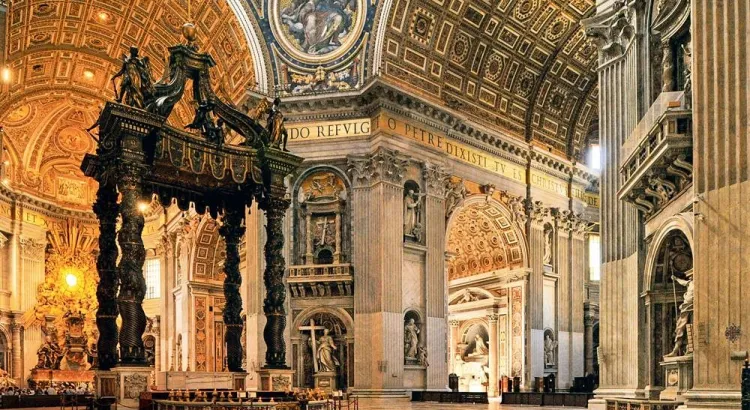
2. When speaking of ‘the riches of the Vatican,’ one must not lose sight of the fact that we are speaking of cultural goods that are the patrimony of humanity, of which the Church is merely the secure custodian. The Vatican, apart from its churches, is a gigantic museum, with libraries, etc. If the Pope were to have to sell these goods to help the poor, then all the more would every nation and state have to sell their own museums, libraries, and cultural patrimonies to help the poor of their own countries. This is absurd, because to transfer these goods into private hands (who could buy them) would be to deprive all scholars and people of all religious beliefs who benefit from them, since the Holy See, which guards them, makes them available to the general public. Countless people from all over the world go there to learn about part of the scientific, philosophical, theological, and artistic patrimony of humanity.
Moreover, this would be no solution to poverty in the world, which depends on the conversion of the hearts of the rulers and magnates of the earth. There are statistics according to which, if the entire Vatican were sold, it would only feed the poor for three days.
We must be aware that this is nothing more than a sophism seeking to discredit the Church.
3. We have said that the Church has grown enormously since the time of Christ. Therefore, one must bear in mind that, as Monsignor Sergio Sebastiani, President of the Prefecture for Economic Affairs, explained (Zenit, July 8, 1999), even though it is an institution whose task is strictly spiritual, it needs money to carry out its work.
Most of the expenses of the Holy See go to maintaining what are called ‘institutional activities’ – a line item in the Vatican budget that covers all the bodies of the Roman Curia: the congregations, the councils, the tribunals, the Synod of Bishops, the offices, etc. In total, these institutions have 2,581 employees. These are all those persons who assist the Holy Father more closely in his ministry in the service of the Church throughout the world. These bodies are called to offer services that do not generate income.
There are even works that only cause economic losses but are maintained because of the apostolic value they represent, such as the newspaper L’Osservatore Romano, which currently has 36,000 subscribers, and Vatican Radio, which now broadcasts in 47 languages (Zenit, June 23, 2000).
4. On the other hand, the Holy See, as well as many Church institutions, helps poor people in a very significant way economically. To give an idea, in the years 1998-1999, ‘Caritas Italiana’ alone distributed 34.5 million dollars destined for 69 countries on five continents (Zenit, January 18, 2000).
As for the Pope’s personal charity, he allocates for works of charity and for supporting the neediest Churches what is called the ‘Peter’s Pence,’ which is the fruit of the offerings of the faithful to help the Pope in his charitable purpose. In 1999, these offerings amounted to $55,313,587, which the Pope then allocated to charitable works (Zenit, June 23, 2000), such as schools, leprosariums, hospitals, special care centers, and areas stricken by great calamities (earthquakes, droughts, famine, etc.).
The Holy See also helps support the Holy Places and missionary works.
The Church cannot be accused of not helping the needy because it does not sell its cultural goods. On the contrary, the great works of mercy that ennoble humanity were invented and initiated by the Church. She invented hospitals, orphanages, homes for the disabled, and the universities themselves. If we can attend a university today, it is thanks to the Church; if we can go to a hospital today, it is thanks to the Church.
5. As for the Pope’s personal life, he lives modestly, without personal property. Don Bosco relates that when he went to visit Pius IX, the pope did not have a single cent left for his personal expenses, and his room was as poor and simple as that of the street children Don Bosco gathered. A journalist recounts that Pope Pius XII died in his room, which was extremely simple, lying on a poor iron bed; his daily meal consisted of a few vegetables. The physician of Saint Pius X, attending him in his illness, was disconcerted to discover that the great Pope, beneath his white cassock, wore trousers patched like those of any poor peasant. The Pope, upon dying, does not even leave his personal belongings to his relatives; he leaves only his teaching and good example. He lives and dies poor, like Jesus.
Fr. Miguel A. Fuentes, IVE
Original Link: Here