Question
Where does the Bible state that Mary was taken up to heaven or that she was conceived without original sin and the other Catholic dogmas?
Answer
As I have repeatedly stated, we Catholics maintain, with foundation, that there are two sources of Revelation: the written and oral Word of God; Scripture and Tradition. We have already proven this. I refer to the arguments established above. Based on them, the Magisterium, according to the needs of the times (in many cases, the various heresies that arose) and theological maturation, has solemnly proclaimed that such and such a truth has been revealed by God and is contained in certain biblical affirmations, and have always been understood in this sense by the Church (Tradition).
Keeping this in mind, we can say that the foundation for upholding the truths considered on this point has been set forth by the Popes in the documents in which the aforementioned dogmas were proclaimed.
Regarding the immunity from original sin (the Immaculate Conception of Mary), there are two points of support in Sacred Scripture.
The first text is the classic passage from Genesis 3:15, (“Then the LORD God said to the serpent: …I will put enmity between you and the woman, and between your offspring and hers; he will crush your head, while you strike at his heel”). If the passage is understood as referring to Christ – the offspring of the woman against whom the offspring of the serpent will rise – then we must see in the woman from whom this offspring proceeds not only Eve, but immediately, Mary, the mother of Jesus. If the enmity is total, it must exclude (as Tradition has understood) any complicity with sin, since “everyone who sins is a slave,” as Jesus says (cf. John 8:34); therefore, not only the offspring of the woman but the woman herself who is the mother of that offspring must be free from all sin. Eve cannot fulfill this, but Mary can.
In the New Testament, the foundation is the passage of the Annunciation, in which the angel calls Mary with the Greek word “kecharitōmenē” (Luke 1:28). This word means, as C. Pozo indicates, that Mary has, in a stable manner, the grace corresponding to her dignity as Mother of God. The reflection of faith, continues the same theologian, discovered that this grace is a “fullness of grace.” Furthermore, that the only fullness that truly corresponds to the dignity of Mother of God is one that is possessed from the first instant of existence, that is, a total holiness encompassing Mary’s entire existence.
These are the foundations; evidently, they are not sufficient by themselves, nor does the Church claim them to be; there is also the interpretation of the entire Tradition of the Church and of the Magisterium in particular.
From the 2nd century onwards, formulas appear indicating the intimate association of Mary and Christ, the Redeemer, in the fight against the devil. The idea is expressed in the Eve-Mary parallel, associated with the new Adam (let no Protestant think that if the parallel is between Eve and Mary/New Eve, then her sin is being hinted at since Eve sinned, for the same parallel places Adam-Christ on the other term; therefore, if Adam is a figure of Christ, not in his sin but in being a principle, the same holds for Eve as a figure of Mary, as the mother of the living “in grace”). We have texts on this matter already in the 2nd century, from Saint Justin, Saint Irenaeus, etc. In the 4th century, the theme of the fullness of grace in Mary is further cultivated, with beautiful texts from Saint Ambrose, Saint Augustine, Saint Maximus of Turin (who says, for example, “Mary, a dwelling fully suitable for Christ, not by the quality of the body but by original grace”), etc. As the centuries pass, the awareness becomes clearer in this regard. The texts can be seen in specialized works. Something worthy of consideration is that there are testimonies of a feast dedicated to the Conception of Mary at the end of the 7th or beginning of the 8th century.
The controversy among Catholic theologians on this topic, which arose around the 12th-14th centuries, is very important, due to theories that considered that the affirmation of the Immaculate Conception of Mary would imply that Our Lady would not have been redeemed. An immaculate conception that opposes the universal redemption of Christ cannot be accepted by Catholic truth; because of this, some theologians, thinking that both truths were incompatible – unless the authentic Magisterium declared the mysterious manner of this compatibility – leaned towards denying this truth, saying that Mary would have been conceived with original sin, but immediately, in the first instant, would have been cleansed from it by the Holy Spirit. We must remember that, parallel to this controversy, the simple people, intuiting the mystery, continued to profess this truth, unaware of the difficult theological speculations. From the 15th century onwards, this truth was professed again with serenity, and even many universities (such as those of Paris, Cologne, Mainz, etc.) imposed the oath to defend the Immaculate Conception before the conferral of academic degrees. It is also noteworthy that the schismatic Council of Basel (1439) defined the doctrine of the Immaculate Conception as a dogma of faith. The Council of Trent explicitly states that its admirable decree on original sin does not intend to touch the particular topic of Mary. Finally, the dogmatic definition by Pius IX arrives, clarifying that Mary is immaculate and the first redeemed (redeemed by anticipation; by the anticipated application of the merits of Christ, and that such doctrine is revealed by God)
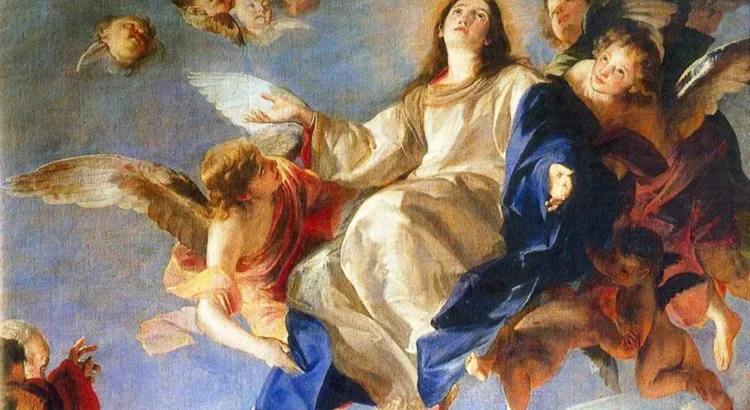
Regarding the Assumption of Mary, that is, the doctrine that says that Mary, after her earthly life, was taken body and soul into heaven (without defining if she passed through death – which most theologians lean towards – or through a state of dormition), finds its biblical foundations also in the text of Genesis 3:15, already cited, for it is based on the most perfect association of Mary with Christ in all His mysteries (the Incarnation, where her consent is asked; the Nativity; her accompaniment in His public life; the beginning of His works at the wedding at Cana; her presence at the foot of the Cross; her presence at Pentecost, etc.), which invite us to consider her association with the mystery of her Son’s death (for many theologians, as I have said), His subsequent resurrection and ascension into heaven, and His coronation. The text of Revelation 12:1 is also often cited (“A great sign appeared in heaven: a woman clothed with the sun, with the moon under her feet and a crown of twelve stars on her head”), although this text is also applied to the Church and the Israel of God.
Pius XII, in the Apostolic Constitution “Munificentissimus Deus,” proceeded in a mixed manner, through an argumentation that appealed to: (a) that the Fathers from the 2nd century affirm a special union of Mary, the New Eve, with Christ, the New Adam, in the fight against the devil; (b) in Genesis 3:15, the fight of Christ against the devil was to end in total victory over the demon; (c) according to St. Paul (cf. Romans 5-6; 1 Corinthians 15:21-26; 54-57), Christ’s victory against the devil was a victory over sin and death; (d) therefore, a special participation of Mary must be affirmed – which should be full, if her association with Christ was full – that ends with her own resurrection and triumph over death.
This is corroborated by testimonies from the most ancient tradition, both from the Fathers and from the liturgy of the Church (the feast of the Dormition has been celebrated in Jerusalem since the 6th century and around 600 in Constantinople), etc. For all these testimonies, see the texts indicated above.
Protestants may disagree with these teachings, but they should recognize that their systematic denials are more recent in time than the testimonies of the Tradition itself. That is why the first apologists called them “innovators”: the innovators or inventors of doctrines.
Fr. Miguel A. Fuentes, IVE
Original Post: Here