Question:
Why does the Catholic Church not accept the priestly ordination of women? Is this not a discrimination that some confessions like Anglicanism have already overcome? Should not Christ’s attitude be understood, perhaps, as specific to His time and now outdated?
Answer:
The problem of the admission of women to the ministerial priesthood is one of the most burning issues in countries with an Anglican tradition and where the proponents of Catholic progressivism have had or have particular strength. Thus, for example, E. Schillebeeckx O.P. says: “…Women… have no authority, no jurisdiction. It is discrimination… The exclusion of women from the ministry is a purely cultural question that now makes no sense. Why can’t women preside over the Eucharist? Why can’t they receive ordination? Why can’t women preside over the Eucharist? Why can’t they receive ordination? There are no arguments to oppose the priesthood of women… In this sense, I am happy with the decision [of the Anglican Church] to confer the priesthood also on women, and, in my opinion, it is a great opening for ecumenism, more than an obstacle, because many Catholics are going in the same direction”.
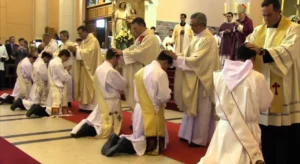
Conversely, the Catholic Magisterium has firmly and invariably maintained the negative position on the possibility of female ordination, and this in documents of a definitive character. What is the ultimate reason why a woman cannot access the ministerial priesthood?
1. Based on Tradition
The Magisterium appeals to Tradition, understood not as an ‘ancient custom’ but as a guarantee of Christ’s will regarding the essential constitution of His Church (and sacraments). This Tradition is reflected in three things: the attitude of Christ, of His disciples, and of tradition; let us look at each of them, also pointing out the main objections usually raised in this regard.
1) The Attitude of Jesus Christ. Historically, Jesus Christ did not call any woman to be part of the twelve. In this, an explicit will must be seen, for He could have done it and thus manifested His will. Jesus Christ had to foresee that by taking the attitude He took, His disciples would interpret it as His will.
Objection. The most common objection is that Jesus Christ acted in this way to conform to the customs of His time and His environment (Judaism), in which women did not perform priestly activities.
Response. Precisely concerning women, Jesus Christ did not adhere to the customs of the Jewish environment. Among rigid Jews, women certainly suffered severe discrimination from the moment of their birth, which extended to the political and religious life of the nation. ‘Woe to him whose children are females!’, says the Talmud. Sadness and annoyance were caused by the birth of a girl; and once grown, she had no access to learning the Law. The Mishnah says: ‘May the words of the Torah (Law) be destroyed by fire before they are taught to women… Whoever teaches his daughter the Torah is as if he taught her calamities.’ Jewish women often lacked rights, being considered as objects owned by men. A Jew recited this prayer daily: ‘Blessed be God who did not make me a pagan; blessed be God who did not make me a woman; blessed be God who did not make me a slave.’
Therefore, Jesus’ attitude towards women contrasts sharply with that of His contemporary Jews, to the point that His apostles were filled with wonder and astonishment at the treatment He gave them (cf. Jn 4:27). For example:
- He conversed publicly with the Samaritan woman (cf. Jn 4:27)
- He disregarded the legal impurity of the hemorrhaging woman (cf. Mt 9:20-22)
- He allowed a sinful woman to approach Him in the house of Simon the Pharisee and even to touch Him to wash His feet (cf. Lk 7:37)
- He forgave the adulteress, showing that one cannot be more severe with the sin of a woman than with that of a man (cf. Jn 8:11)
- He distanced Himself from the Mosaic law to affirm the equality of rights and duties of men and women regarding the matrimonial bond (cf. Mt 19:3-9; Mk 10:2-11).
- He was accompanied and supported in His itinerant ministry by women (cf. Lk 8:2-3)
- He entrusted them with the first Easter message, even announcing His Resurrection to the Eleven through them (cf. Mt 28:7-10 and parallels)
This freedom of spirit and this distancing are evident to show that if Jesus Christ wanted the ministerial ordination of women, the customs of His people did not represent an obstacle for Him.
2) Attitude of the Apostles. The apostles followed the practice of Jesus regarding the priestly ministry, calling only men to it. And this despite the fact that the Blessed Virgin Mary occupied a central place in the community of the first disciples (cf. Acts 1:14). When they had to replace Judas, they chose from among two men.
Objection 1. The same objection can be raised: the apostles also adhered to the customs of their time.
Response. The objection has less value than in the previous case, because as soon as the Apostles and Saint Paul left the Jewish world, they were forced to break with Mosaic practices, as seen in Paul’s discussions with the Jews. Now, unless they were clear about Christ’s will, the new environment in which they began to move would have had to induce them to female priesthood, for in the Hellenistic world many pagan cults were entrusted to priestesses.
Their attitude cannot be due to distrust or contempt for women either, for the Acts of the Apostles demonstrate with how much confidence Saint Paul requests, accepts, and thanks the collaboration of notable women:
- He greets them with gratitude and praises their courage and piety (cf. Rom 16:3-12; Phil 4:3)
- Priscilla completes Apollos’ formation (cf. Acts 18:26)
- Phoebe is in the service of the church of Cenchreae (cf. Rom 16:1)
- Others are mentioned with admiration like Lydia, etc.
- But St. Paul makes a distinction in the very language:
- When referring to men and women indistinctly, he calls them ‘my fellow workers’ (cf. Rom 16:3; Phil 4:2-3)
- When speaking of Apollos, Timothy, and himself, he speaks of ‘God’s fellow workers’ (cf. 1 Cor 3:9; 1 Thes 3:2).
Objection 2. The apostolic and especially Pauline dispositions are clear, but they are dispositions that have already expired, as others have, for example: the obligation for women to wear a veil on their head (cf. 1 Cor 11:2-6), not to speak in the assembly (cf. 1 Cor 14:34-35; 1 Tim 2:12), etc.
Response. As is evident, the first case (the female veil) concerns disciplinary practices of little importance, while admission to the ministerial priesthood cannot be placed in the same category. In the second example, it is not about ‘speaking’ in any way, because Saint Paul himself recognizes the woman’s gift of prophesying in the assembly (cf. 1 Cor 11:5); the prohibition concerns the ‘official function of teaching in the Christian assembly’, which has not changed, because as such it belongs only to the Bishop.
3) Attitude of the Fathers, the Liturgy, and the Magisterium. When some heretical Gnostic sects of the first centuries wanted to entrust the priestly ministry to women, the Church Fathers judged such an attitude unacceptable in the Church. Especially in the canonical documents of the Antiochene and Egyptian tradition, this attitude is pointed out as an obligation to remain faithful to the ministry ordained by Christ and scrupulously preserved by the apostles.
In the Light of Sacramental Theology
The central argument is the one outlined above; we can, however, access another argumentative path that highlights more clearly that the tradition dating back to Christ is not a mere disciplinary disposition but has an ontological basis, that is, it rests on the very structure of the Church and the sacrament of Holy Orders. The two arguments we give below appeal to sacramental symbolism.
1) The Ministerial Priesthood is a Sacramental Sign of Christ the Priest. The ministerial priest, especially in his central act which is the Eucharistic Sacrifice, is a sign of Christ the Priest and Victim. Now, a woman is not an adequate sign of Christ the Priest and Victim, therefore she cannot be a ministerial priest.
Indeed, sacramental signs are not purely conventional. The sacramental economy is founded on natural signs that represent or signify a natural likeness: thus bread and wine for the Eucharist are adequate signs because they represent the fundamental food of men, water for baptism as the natural means of cleaning and washing, etc. This applies not only to things but also to persons. Therefore, if in the Eucharist it is necessary to express sacramentally the role of Christ, a ‘natural likeness’ between Christ and His minister can only occur if such a role is performed by a male.
In fact, the Incarnation of the Word took place according to the male sex. It is a matter of fact that relates to the whole theology of creation in Genesis (the relationship between Adam and Eve; Christ as the new Adam, etc.) and that, if someone disagrees with it or its interpretation, still faces the undeniable fact of the masculinity of the incarnate Word. If desired, therefore, one would have to discuss why God incarnates in a male and not in a female; but starting from the fact that it was so, it cannot be disputed that only a male adequately represents Christ-the-male.
Objection 1. The objection of Anglicans inclined to female ordination is that, according to them, the fundamental aspect of the incarnation is not that Christ became male but that He became ‘man’. Therefore, it is not so much the male who adequately represents Christ but the ‘human being’ as such.
Response. The problem with the objection lies in an insufficient concept of what is called, in sacramental theology, ‘adequate representation’. Sacramental signs must maintain an adequate representation, i.e., as specific as possible. From this point of view, the ‘human being’ (male-female) is an adequate representation of Christ but in His common priesthood (the common priesthood of the faithful), not of Christ in His ministerial Priesthood of the New Covenant. The ‘human being’ adequately represents the Word made flesh, but represents only generically and vaguely Christ the priest. In fact, the priestly (ministerial) character is a sub-specification of the general Christian character given to every human (male and female) by baptism.
Objection 2. Christ is now in the celestial condition, whereby it is indifferent whether He is represented by a man or a woman, since ‘in the resurrection they neither marry nor are given in marriage’ (Mt 22:30).
Response. This text (Mt 22:30) does not mean that the glorification of the bodies suppresses the sexual distinction, because this is part of the person’s own identity. The distinction of the sexes and, therefore, the own sexuality of each one is the primordial will of God: ‘male and female he created them’ (Gn 1:27).
2) Nuptial Symbolism. Christ is presented in Sacred Scripture as the Bridegroom of the Church. In fact, in Him all the nuptial images of the Old Testament that refer to God as the Spouse of His people Israel are fulfilled (cf. Hos 1-3; Jer 2, etc.). This characterization is constant in the New Testament:
- In Saint Paul: 2 Cor 11:2; Eph 5:22-33
- In Saint John: Jn 3:29; Rev 19:7.9
- In the Synoptics: Mk 2:19; Mt 22:1-14
Now, this highlights the masculine function of Christ regarding the feminine function of the Church in general. Therefore, for the subject who serves as the matter of the sacrament of Holy Orders (who represents Christ), and then the subject who serves as the minister of the Eucharist (who acts ‘in persona Christi’) to be an adequate sign in the sacramental symbolism, he must be a male.
Objection. The priest also represents the Church, which has a passive role regarding Christ. Now, a woman can adequately represent the Church; therefore she can also be a priest.
Response. It is true that the priest also represents the Church and that this could be carried out by a woman. But the problem is that he does not only represent the Church but also Christ, and this, for all that we have said, cannot be represented by a woman. Therefore, the male can represent both aspects, but the woman only one, which is not the proper priestly one.
Conclusion
The main errors revolve around two problems. The first is not adequately conceiving the sacramental priesthood, confusing it with the common priesthood of the faithful. The second is letting oneself be carried away by prejudices that see in the ministerial priesthood a discrimination against women and, in parallel, an exaltation of the male to the detriment of the woman; it is a lack of perspective: in the Catholic Church, the ministerial priesthood is a service to the People of God and not an aristocratic matter; moreover, the latter is, precisely, an abuse of the ministerial priesthood, similar to that which contaminated the Pharisaism and Sadduceeism of the Gospel times. Finally, the greatest in the Kingdom of Heaven are not the ministers but the saints; and -excluding the humanity of Christ- the highest of creatures in honor and holiness, the Virgin Mary, was not vested by God with any priestly character.
Fr. Miguel A. Fuentes, IVE
Original Post: Here