Article:
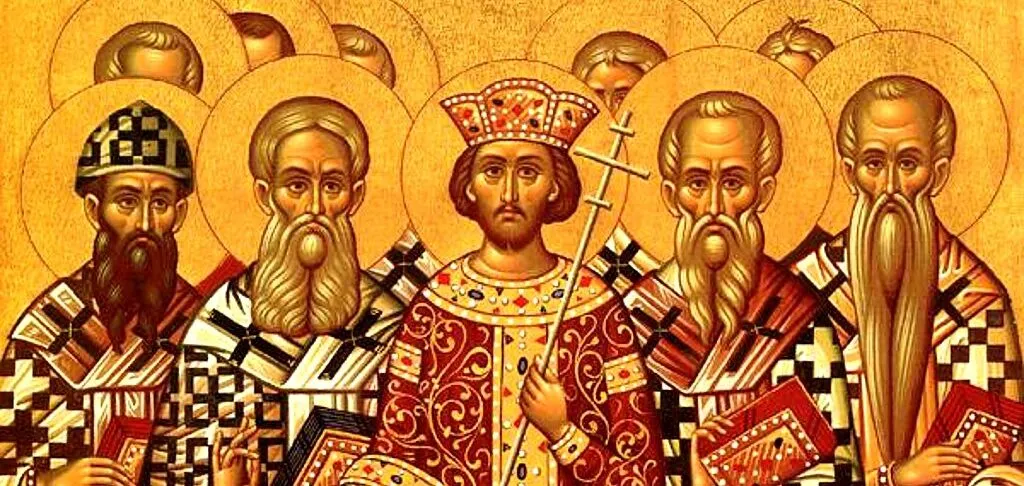
Before introducing some of the figures of Nicaea, let us explain what Nicaea is. That is, let us begin with the end. Nicaea or Nikaia was an ancient city in Bithynia, Asia Minor, very close to Constantinople. Today it is called Iznik (Turkey), and it was here that Emperor Constantine convened the council in 325 AD that made it famous. But when we ask what Nicaea is, we are not interested for the moment in geographical or historical details, but in the doctrine of its Creed or Symbol.
The so-called “Nicene Creed” is recited by us every Sunday within the profession of faith known among us as the “Long Creed.” The liturgy offers us the possibility of praying one of two creeds: the “short” one, or Apostles’ Creed; and the “long” one, or Niceno-Constantinopolitan Creed. In many parts of the world, only this second one is used. As its name indicates, it is the Creed or Symbol of faith that combines the Creed elaborated by the conciliar fathers at Nicaea in 325 AD, and the one expanded half a century later by the fathers of the Council of Constantinople in 381 AD. Modifications to the Symbols of faith have generally been due to the need to clarify specific points of the faith circumstantially denied by some major heresy. They are not changes in the formulation but clarifying additions. What these additions contribute is not new doctrine, but the faith of always, peacefully professed by the Church until that moment, but which, due to some reigning heresy or confusions spread among the people by bad theologians, urgently needs to be made clear.
In the case of Nicaea, according to Sesboüé, it is nothing more than the creed of the (regional) council of Caesarea (from the mid-3rd century; cf. DS 40), expanded to respond to the Arian heresy. Here it is, with the clarifications indicated in italics and capitals:
We believe in one God,
the Father almighty,
maker of all things visible and invisible; and
in one Lord, Jesus Christ, the Son of God,
the only-begotten begotten of the Father,
THAT IS, OF THE SUBSTANCE OF THE FATHER, (τοῦτ’ ἐστιν ἐκ τῆς οὐσίας τοῦ Πατρὸς),
God from God, Light from Light, true God from true God,
BEGOTTEN, NOT MADE, ( γεννηθέντα οὐ ποιηθέντα)
CONSUBSTANTIAL WITH THE FATHER, (Ὁμοούσιος τῷ Πατρί),
THROUGH WHOM ALL THINGS WERE MADE,
those in heaven and those on earth,
who for us men and for our salvation
came down and was incarnate, was made man,
suffered, and rose again on the third day,
[and] ascended into the heavens,
and is coming to judge the living and the dead,
and in the Holy Spirit (DS 125).
The four added clarifications aim to underline the divinity of Jesus Christ and make the subtleties of Arianism perfectly clear; because Arius and his defenders subscribed to the previous Symbol, in which we already read that Jesus is “the Son of God, the only-begotten begotten of the Father,” “God from God, Light from Light, true God from true God.” Any believer understood that the divinity of Jesus Christ was being proclaimed, but Arius nuanced the scope of these affirmations, making Christ a creature, the most exalted one imaginable, but always a creature. I will address the problem of Arius on another occasion. For now, I only want to highlight the forcefulness of these dogmatic affirmations.
Jesus Christ is begotten “of the substance of the Father.” This is not a new affirmation but an explication, as the initial clause “that is” (toutestin) makes clear; therefore, this is already contained in the previous phrase speaking of the generation of the Son; and if Arius understood it in a diminished sense, it is because he diluted the faith to accommodate it to his rationalist concepts. Arius, like all Gnostics, reduced faith to the limits of the rational, at least as much as he could. Nicaea reminds the innovator that true generation, and therefore true filiation, implies that divine generation, like natural generation, is from the substance of the generator.
But the Arians and their philo-Arian followers were masters of subtleties and fine ambiguities, in which a “yes” is so close to a “no” or a “maybe yes, maybe no,” that the conciliar Fathers tightened the screw with new turns, because they were truly unwilling to let the heretics slip their poison through even the tiniest hole, no matter how insignificant it seemed. And that is why they added “begotten, not made.” Because the Arian Christ is a creature of the Father. The Christ of the Catholic faith is not made, but begotten. He is a Son in the full, absolute, total sense; not an adopted son. And as the fine and definitive adjustment comes the “dogmatic word” of Nicaea: “consubstantial” with the Father, «homoousios». So fine, exact, and precise that the Arians saw they had no room for their dodges here, and they brought all their weapons to bear trying to disarm its meaning. To this day, it is debated who proposed the term. Some say it was Hosius, bishop of Córdoba, Spain, the Pope’s legate to this Council; others say the young deacon Athanasius, the great champion of Nicaea (who would still suffer so much for the faith). In Greek, homoousion to Patri, means exactly the same as the Latin version consubstantialem Patri. Ousia was not a new word in theological discussions; but it had been distrusted—and had even been condemned previously—because Paul of Samosata proposed it in the sense of “nature” and with the intention of speaking of a plurality of natures in the Trinity. Here, however, it indicates substance and emphasizes “of the same” as the Father. This implies at the same time a distinction of persons, because, as Saint Basil would say, nothing is said to be consubstantial with itself, but with another. Therefore, this word was a kick right in the middle of the Arian teeth.
Some modern translations render it as “of the same nature as the Father.” The expression is not a happy one, although it is not strictly speaking an error, since it is understood from the context that the intention is to take “nature” in the sense of “substance,” and, furthermore, because the Latin reference remains (which Saint Paul VI, by the way, recommended singing at Sunday Mass in one of its Gregorian melodies, which would avoid idle discussions for anyone with scruples). But let’s acknowledge that they are not totally equivalent. Two men are of the same nature, but they are not consubstantial Anyway, if the sense is clarified, it can pass (and in passing, it makes for a good parish sermon); and the problem is rather the imprecision and not a desire to introduce a heresy; because nowadays, heresies are proclaimed with megaphones, so the problem doesn’t come from a somewhat generic translation (although it can start there). In any case, if one wants to say what Nicaea said, it would be good to use consubstantial, as, in fact, we say when we recite it in Latin.
So accurate was the word that some of the most lucid philo-Arians sought an escape by accepting the term but transcribing and endorsing it with the addition of a very tiny letter of the Greek alphabet: an iota (= ι). So instead of homoousios they said and wrote homoiousios. That iota changed the meaning from “consubstantial” to “of similar substance.” What a difference a single letter can make! And the masters of vagueness knew this very well. Today they do something similar, but without changing the words: they change the meaning, or stretch it so that everything fits inside, or so that it says nothing. The love for the word has been lost, and that is why many have lost faith in the Word, both the revealed and the incarnate one.
But God from time to time sends some Hosiuses and Athanasiuses who spoil the stew for the cleverest. I look out the window every day to see if one appears. And I do not lose hope.
Fr. Miguel Ángel Fuentes, IVE
Original Post: Here