Question:
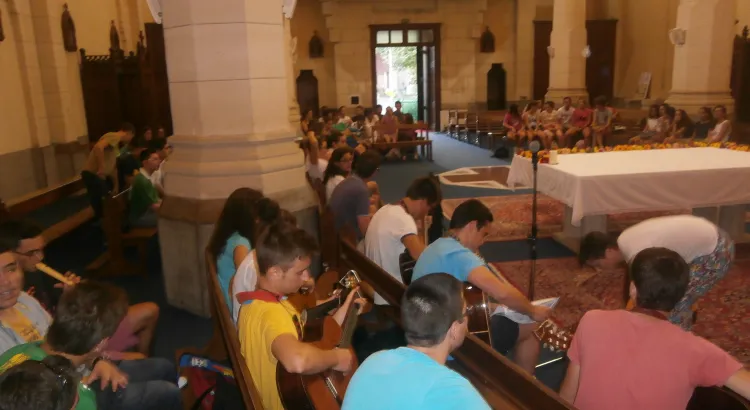
I would like to know if there is a document that mentions the use of the guitar within the Mass and also about applause.
Answer:
To address the topic of the use of instruments in the liturgy, and in particular the guitar, it would be helpful to recall, as Cardinal Ratzinger teaches, that “Christian liturgy is defined by its relationship with the Logos” (we freely follow J. RATZINGER, The Spirit of the Liturgy. An Introduction, Cristiandad ed., Madrid 2001, 171-179). This is in a triple sense:
- In liturgical music, based on biblical faith, there is a “clear primacy of the word.” From this follows “the predominance of song over instrumental music (which by no means should be excluded).”
- Song manages to surpass words, which are often insufficient to express the ineffability of the mystery, but it does not surpass the Word (the Logos), which is why music becomes necessary. However, “Christian liturgy is not open to just any type of music.” Music that “drags man into the intoxication of the senses, tramples rationality and subjects the spirit to the senses” does not elevate man. Therefore, liturgical music must be such that, surpassing sensuality, it elevates the heart (sursum corda, “lift up your hearts”).
- “Human music is all the more beautiful the more it adapts to the musical laws of the universe.” The liturgy must be cosmic, that is, open to the song of the angels “who surround God and illuminate the universe.” “When we celebrate Holy Mass, we incorporate ourselves into this liturgy that always precedes us. Our song is a participation in the song and prayer of the great liturgy that encompasses all creation.” Therefore, in the liturgy, the songs should be such that they can be sung in the presence of the angels. Instruments are the choir of creatures that accompany the voice of man in divine praise.
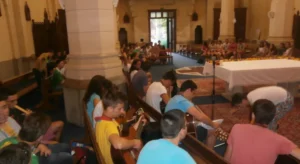
Well then, based on these principles, we reformulate the question: Can the guitar be used in the liturgy? We believe it cannot be ruled out outright, but its acceptance will depend on the type of music it serves and its manner of execution.
In Jewish liturgical music, stringed instruments were used to “accompany” (and we emphasize this verb, “accompany”) the singing of the psalms. In fact, “psaltery” comes from the Greek “psallein” (translation of the Hebrew “zamir”), which means “to pluck” (a string), and to psalmody is to sing with the accompaniment of a zither or a harp, or a similar instrument. From this, one can infer the exclusion of the “strummed” guitar, which privileges rhythm, and places itself above the word and at the level of the senses. Indeed, the guitar played in this way resonates in the heart, but does not elevate it.
The Popes have always been concerned with correcting abuses in matters of liturgical music, above all so that the liturgy is not confused with a theatrical performance of an operatic type. Thus, for example, Benedict XIV, in the Encyclical Annus Qui of 1749, delimited the use of musical instruments, admitting: “…the organ, also violins, cellos, bassoons, violas and violins” and excluding “kettledrums, hunting horns, trumpets, oboes, flutes, piccolos, modern psalteries, mandolins and similar instruments, which only serve to make the music more theatrical.” Guitars are circumscribed here. However, the concern was directed not so much at certain instruments but at those that represented this type of music. “In a similar way, Pius X attempted, at that time, to distance operatic music from the liturgy, declaring Gregorian chant and the great polyphony of the time of Catholic renewal (with Palestrina as a prominent symbolic figure) as the criterion for liturgical music. Thus, liturgical music must be clearly distinguished from religious music in general…” (J. RATZINGER, The Spirit of the Liturgy…, 169).
If we consider the current use of the guitar, that is, for folk or popular song, melodic singing, even rock (with the electric guitar), it does not seem to be a suitable instrument for the liturgy. But if it is played with art and by plucking the strings, in such a way that it serves as an accompaniment, we believe it could be used, just as the zither and the harp can be used. The problem, in any case, would be: For what type of music that is suitable for the liturgy can the guitar be used as an accompanying instrument? And to what texts will it lend its sound?
Perhaps its liturgical use, therefore, is reduced to accompanying the psalms in the Liturgy of the Hours, in the manner of a zither or harp. This does not preclude using this beautiful instrument for other types of religious, but extra-liturgical, songs, such as, for example, in certain types of gatherings and events.
The Constitution on the Liturgy, Sacrosanctum Concilium, of the Second Vatican Council, states: “In the Latin Church the pipe organ is to be held in high esteem, for it is the traditional musical instrument which adds a wonderful splendor to the Church’s ceremonies and powerfully lifts up man’s mind to God and to higher things.
But other instruments also may be admitted for use in divine worship, with the knowledge and consent of the competent territorial authority, as laid down in Art. 22, 52, 37, and 40. This may be done, however, only on condition that the instruments are suitable, or can be made suitable, for sacred use, accord with the dignity of the temple, and truly contribute to the edification of the faithful” (n. 120).
Regarding applause in the liturgy, let us say, first of all, that it is opposed to the decorum and beauty proper to the liturgy. It is the worship of the Bride of Christ, in which order, moderation, and restrained manifestations must shine forth.
There are artistic manifestations that are introduced into the liturgy to make it more attractive, such as the inclusion of a dance before the Gospel, which generally ends in spontaneous applause from the faithful, “which is justified,” says Cardinal Ratzinger, “if one considers, properly speaking, their artistic talent.” But, concludes the current Pontiff, “when there is applause for a human achievement within the liturgy, we are faced with a clear sign that the essence of the liturgy has been totally lost…” (The Spirit of the Liturgy. An Introduction, Cristiandad ed., Madrid 2001, 223).
When there is applause, who is being applauded? If a person is applauded for a speech, or because they have made religious vows, or gotten married, or because they sang very well, etc., we are facing a denaturalization of the liturgy, which is the worship rendered to God and not to man, even if it is to praise the “marvels” of God in man.
On the contrary, if it is God who is being applauded, then it must be said that the liturgy has its own ways of praising God and expressing jubilation, and that is through acclamations, that is, the singing of the Alleluia, the Amen, the Deo gratias, etc. Applause is very linked to profane use. Let’s give an example. Just as in the liturgy there are proper ways to greet and a common and vulgar “Good morning!” is out of place, but rather a biblical (though no less simple) “The Lord be with you!”, accompanied by an extending and joining of the arms by the one who greets (as a stylized and liturgical form of the human embrace), so too is applause out of place as a sign of approval or confirmation, or as an expression of jubilation, for these feelings of the soul have their stylized form in the acclamations.
Fr. Jon M. de Arza, IVE
Original Post: Here