Question:
Dear Father Miguel, I have been Catholic all my life, and for the past 8 years, I have belonged to a Catholic Community in El Salvador. Days ago, I was conversing with separated brethren about the Rosary, and I have been asking myself the following: 1.) Why in the Rosary do we pray one Our Father and ten Hail Marys? 2.) The first part of the Hail Mary is in the Bible and is the greeting of the Angel Gabriel to Mary. So, how did the second part, ‘Holy Mary, Mother of God…’ come about? Thank you for your attention to my concerns. Sincerely, J. C. A.
Answer:
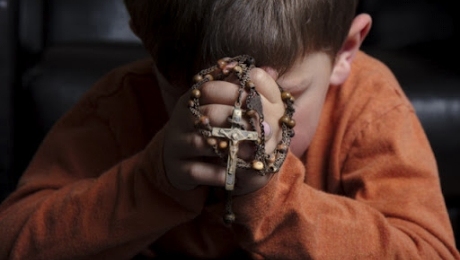
1. The formation of the Holy Rosary is not entirely clear regarding its origin. The use of counting prayers with beads or pebbles is very ancient, both among Christians and pagans. In the 4th century, the monk Paul used to count his Our Fathers with small stones. The use of the Rosary became common in the 15th century, after the propagation of the devotion to the Rosary. For some, its formation was a slow evolution. It is commonly presented that St. Dominic received this prayer from the hands of the Virgin Mary. In fact, the Virgin in her apparitions, the Church through her pastors, and the history of the saints (who always prayed it daily) demonstrate that the recitation of the Rosary is pleasing to God.
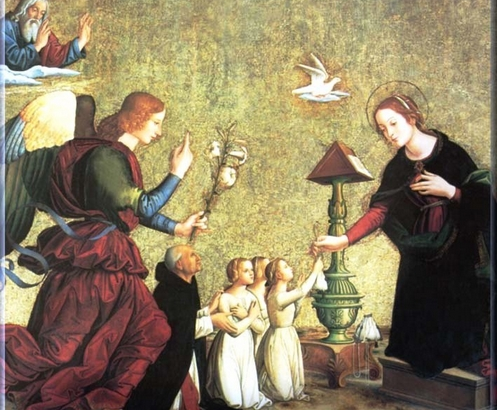
2. The first part, which is a praise of the Most Holy Virgin Mary, is composed, as you say, of the words of greeting of the Archangel Gabriel on the day of the Annunciation (Lk 1:28) and those of St. Elizabeth on the day of the Visitation (Lk 1:42). The Church has added to these greetings the names of Mary and Jesus.
The two greetings combined, with the inclusion of the name of Mary (though still lacking that of Jesus), are found as a collect prayer for the Fourth Sunday of Advent in the antiphonary of St. Gregory (died 604). Probably, the use of repeating to the Most Holy Mary the two greetings combined dates back at least a century earlier, since it is found in the most ancient Antiochian liturgy, that of St. James. The name of Jesus appears for the first time in the 6th century. In repeating to Mary the greeting of the Archangel together with the blessings of St. Elizabeth, we endeavor to rejoice with her for the singular privileges and gifts that God granted her above all creatures, and we bless and give thanks to God together for having given us Jesus Christ through Mary.
The second part of the Hail Mary was composed in relatively recent times. It seems that the use of adding, to the words of praise of the collect prayer of St. Gregory, an invocation asking for the help of the Virgin Mother of God, is due to the first Franciscan period (13th century). The current form is found used in various places around the middle of the 15th century; it was later adopted by Pope St. Pius V in his edition of the Breviary (the prayer book of the religious) in 1568, and from then on it came into common use. With the second part of the Hail Mary, we ask the Virgin for her maternal intercession for us during the course of our lives and especially at the hour of our death, where we hope that the Most Holy Virgin will assist us and obtain for us from God the grace of final perseverance—that is, the grace to die in a state of grace and to go to heaven to enjoy God eternally.
I remind you that many of our separated brethren find it difficult to accept the recitation of the Holy Rosary for some very specific reasons that one must bear in mind when conversing with them: they do not believe in the intercession of the Most Holy Virgin Mary for us (nor in that of any other saint, a veneration which they consider, erroneously and contrary to the very will of God, idolatrous); they do not accept that Mary is the Mother of God, being the Mother of Christ (indeed, many of them do not accept the Divinity of Our Lord); and they do not believe that the Church can perform acts of teaching—that is, teach Christians how they should pray, or anything resembling it—forgetting that it was Jesus Himself who commanded the Apostles to teach the peoples and to confirm their faith, giving them an authority that He equated with that of God (‘Amen, I say to you, whatever you bind on earth shall be bound in heaven, and whatever you loose on earth shall be loosed in heaven.’ Mt 18:18).
One must also bear in mind the excellence of the Holy Rosary, which is a source of graces for those who pray it with devotion and love. In the course of the Our Fathers (the prayer taught by Christ) and Hail Marys (a prayer also taken, in its first part, as we have seen, from Sacred Scripture), one contemplates the most excellent mysteries of the life of Christ and of Mary, such that there is no prayer more biblical than this. Moreover, in almost all the apparitions of the Virgin, she asks that men pray the Holy Rosary every day, promising heaven to those who do so. The Popes have also shown the excellence of this prayer by granting many indulgences to those who recite it. For all these reasons, we realize the importance of the recitation of the Rosary, and we cannot help but resolve to pray it and to motivate others to pray it as well. Not to do so is to deprive oneself absurdly of countless graces and of the maternal protection of Mary.
Fr. Miguel A. Fuentes, IVE
Original Post: Here