Question:
I have received several objections on this topic that challenge this truth; for example:
“Read the New Testament, where does it mention Mary’s role? Since when is she a mediator? In a Catholic magazine, I read that ‘if we can rightly say that Jesus is the path that leads us to the Father, He is also the path that leads us to Mary.’ I confess that this statement has filled me with astonishment. One is accustomed to the figure of Mary and the Saints being exalted within Catholicism without biblical foundation. Thus, one has often heard that she is Mediator (even though Jesus said, ‘I am the Way… no one comes to the Father except through me’), Co-Redemptrix (as if the Blood of Christ were not of infinite value and sufficient to redeem us). But one had not yet read that Christ was demoted to a mediator between us and the Virgin. So many idolatrous connotations in the Catholic Church sometimes make one start to not understand anything. Between the Pope, the Virgin, the Saints, is there any room left for Jesus? Frankly, reading Scripture, one arrives at Luther before arriving at the Vatican.”
“I don’t understand why in the Catholic Church, they insist on placing Mary as a mediator for men and women with God, when Jesus himself tells us that he is the way, the truth, and the life, and no one comes to the Father except through him. This message is clear.”
Answer:
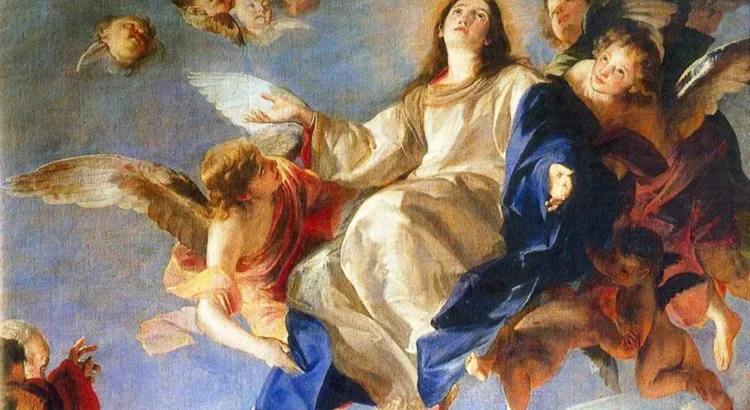
Alongside her perpetual virginity, the most difficult concept for Protestants is the “place” that Mary occupies in the Catholic doctrine of salvation, that is, her mediating or intercessory function. We have hinted at this when speaking about the “cult of the saints.” We have already established that it is not a matter of worship, an act which, if directed towards a creature distinct from God, is condemned by Catholic doctrine as a most grave sin.
Converts to Catholicism have recognized this: “the Catholic doctrine that was most difficult for me to accept was the role of Mary in the Church (…) I had always believed that asking Mary to intercede for us was contrary to the Bible’s teaching that Christ is the ‘one mediator between God and the human race’ (cf. 1 Tim 2:5),” says Tim Staples, for example.
In few other episodes of the Gospel does the Virgin’s mediating role appear so magnificent, alongside its intrinsic relationship with Jesus Christ. She herself says to the servants at the feast: “Do whatever he [Jesus] tells you.” With her mediation, she does not displace Jesus, but rather leads people to Jesus.On one occasion, a person wrote to me with a few lines against this interpretation of the episode, saying that “At the wedding at Cana, it was not intercession; it was a concern of Mary for her friends who were getting married. And you cannot base doctrine on a single Bible passage. The separated brethren, as you call them, are correct, because the only basis of faith is the Bible, and little is said about Mary there, isn’t that true? She only appears in a few passages, and Catholics (brethren without Christ) give much importance to Mary, and the Bible does not. You are Mariologists, not Christians; and you believe more in tradition than in the Bible.” One would have to say a few things to this person regarding their doctrine, for example: in what part of the Bible (which is, according to them, “the only basis of faith”) does the Bible say that “you cannot base doctrine on a single Bible passage”? Or simply, where does it say that there is a distinction between intercession and concern, or that concern is not part of intercession? All this is non-biblical doctrine, without biblical foundation! Why should I believe it, if the Bible doesn’t say it? But, we have already spoken about this. I quote the letter to show the weakness of the arguments. What this person calls “concern” is nothing other than intercession; moreover, in the Gospel of Saint John, it does not say that Mary was merely concerned, but that she spoke to Jesus, asked Jesus, and told the servants to act according to her Son’s instructions. That a single passage is not enough to establish doctrine – what theological foundation does that have? Does it not say in one place in all of Scripture: “And the Word became flesh” (Jn 1:14)? Should we strip value from all biblical texts that have no parallels? Evidently, the person who wrote that to me doesn’t even believe it herself. She writes to waste others’ time.
On the Cross, Jesus entrusted Mary with the care of John, just as He entrusted John with the care of Mary (cf. Jn 19). We see in this passage the “proclamation” of Mary’s spiritual motherhood over all humanity (not the beginning of her spiritual motherhood but its declaration, for the beginning coincides with that of her divine motherhood, since upon beginning to be the mother of the Head of the body of Christ, as Saint Paul calls the Church, she began to be the mother of the whole body). Perhaps many Protestants will not accept this truth, but they cannot deny the charge. The charge to care for John, to watch over him and protect him… that is what we consider part of this intercession. Jesus on the Cross was still God, and in death, His divinity did not separate from His body or His soul (only the body and soul separated from each other). Why this charge? Could Jesus not have taken care of this Himself? Did death deprive Him of His power? Did His power over the disciples diminish because Mary began to take care of John (and with John, also the other apostles and disciples, as we see Saint Luke say in Acts 1:14)?
The Apostle James, speaking about intercession, says: “The fervent prayer of a righteous person is very powerful.” (James 5:16). Why should this power be denied to Mary’s prayer? And if it is not denied, then why is her intercessory power denied? If prayer’s power is not for interceding, asking, and obtaining something for oneself or for others, then what is the power of prayer for? And Saint Paul, in Eph 6:18, commands us: “With all prayer and supplication.” If we all can and should pray for one another, why can Mary not pray for us? And if Saint Paul commands us to pray, it is because prayer is effective; but if our prayer is effective before God, is that not “interceding”? In 2 Thes 3:1, Saint Paul asks the Thessalonians: Finally, brothers, pray for us, so that the word of the Lord may speed forward and be glorified, as it did among you, and that we may be delivered from perverse and wicked people, for not all have faith.” And if Mary did this during her earthly life in this world, why can she not do it now that she is in heaven? There is an incoherence in Protestant doctrine, which is due to a doctrinal prejudice and not a serene study of the same biblical texts.
The strongest text that Protestants adduce against the mediation of Mary (and of any saint) is the passage from 1 Tim 2:5: “For there is one God. There is also one mediator between God and the human race, Christ Jesus, himself human.” But the passage is not well interpreted if it is understood as an exclusion of other intercessors. Saint Paul says there that salvation comes to us only through Christ: from God to all people – without exception – salvation comes through Christ, through His humanity, that is, through His incarnation, through being true man and true God at the same time, the supreme High Priest. This means that there is no salvation that can be obtained outside of Christ. But it does not mean that, in the obtaining of that salvation, there is no place for the prayers of the righteous, the penances that we do for one another, and in particular the prayers of Mary. Mary is not the author of the grace that saves but an intercessor, so that God’s heart may look upon us benevolently and have mercy on us.
One final word for the interlocutor who was scandalized by the expression “Jesus leads us to Mary.” We Catholics do not understand this – when we use this expression – as a subordination of Jesus to Mary; it simply means that He wants us to recourse to His Mediation (that of Jesus) through Mary. This was not invented by a pious Catholic but by Christ Himself. It was He who said to John: “Behold, your mother”; is that not leading men (at least John) to Mary? All that we have said can also be applied to the so-called Marian co-redemption and to the Catholic dogmas that associate Mary in the work of our salvation.
I believe the doctrine of one of the saints most devoted to Mary, in one of the works that has most influenced Marian piety, can be illustrative: Saint Louis Marie Grignion de Montfort and his Treatise on True Devotion to Mary. There the saint, while vigorously defending the (subordinate, understand) mediation of Mary and her role in the work of salvation, says with all clarity, speaking of “the necessity of the cult of Mary”: “I confess with the whole Church that Mary, being a mere creature fashioned by the Most High, compared to His infinite Majesty, is less than an atom, or rather is nothing, since He alone is ‘He Who Is’ (Ex 3:14). Consequently, this great Lord, always independent and self-sufficient, never had and does not have any absolute need of the Blessed Virgin to carry out His will and manifest His glory. To do all things, He has only to will them. I maintain, nonetheless, that considering things as they are, since God willed to begin and complete His greatest works through the Blessed Virgin from the moment He formed her, it is to be believed that He will not change His plan; He is God and does not change in His sentiments or His way of acting (Mal 3:6; Rom 11:29; Heb 1:12).” Later, the saint will call this necessity of Mary: “hypothetical necessity,” that is, founded not on an absolute or natural necessity but on the unfathomable designs of God, who has willed to carry out His work in this way. Shall we object to God about this? If we ourselves are not absolutely necessary and yet we exist and God wants to work in us and through us, will anyone dare to object to Him for having chosen Mary and given her the place He gave her?
Fr. Miguel A. Fuentes, IVE
Original Post: Here