
Question:
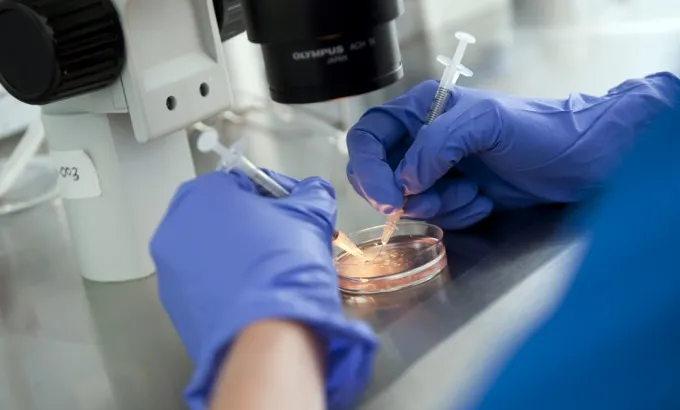
The reason for this letter is to thank you for such an instructive and necessary opportunity to respond to the concerns that the Catholic faithful may have. I would like to ask you the following: my wife and I have been married for six years and have not had the joy of conceiving a child. We spoke with a doctor to see if we had any problems; apparently, physiologically there is no issue. He proposed the following, which is my question: To take a sample of my semen, select the best sperm, and then, using a cannula, place them in my wife’s uterus to increase the chances of fertilization. Is this against what the Church teaches?
Thank you again very much.
Answer:
Dear Sir,
In what you have presented to me, two issues that may present moral objections must be resolved:
- a) The method of obtaining the sperm.
- b) The relationship between the act of the doctor and the conjugal act that you, the spouses, are to perform.
I. REGARDING THE OBTAINING OF SPERM
Techniques for obtaining male semen can occur in three different contexts:
1st. In connection with the sexual relationship:
a) Following ‘coitus interruptus’
b) Using a condom
2nd. After a conjugal act:
a) Using a perforated condom
b) Collecting the semen from the depths of the vagina
c) Collecting the residual semen from the male urethra
3rd. Separately from the conjugal act:
a) Through masturbation
b) Collecting semen from the urethra after involuntary emission (nocturnal emission)
c) Through electroejaculation
d) By expressing the prostate and seminal vesicles
e) Through puncture of the epididymis and vas deferens
f) Through testicular biopsy
Regarding morality, a distinction must be made:
1st. When the obtaining of semen is independent of the voluntary exercise of the sexual organ, the methods used do not present a moral problem (they may present technical deficiencies insofar as the semen is not capable of fertilization, thus serving to determine some diseases but perhaps not to identify the causes of male sterility). This includes techniques such as expressing the prostate and seminal vesicles, puncture of the epididymis and vas deferens, testicular biopsy; likewise, collecting semen after an involuntary emission.
2nd. In contrast, when the obtaining of semen is related to the voluntary exercise of the sexual organ, the act of obtaining must respect the fundamental dimensions of the conjugal act, namely both its unitive and procreative dimensions. This implies:
a) That obtaining it through masturbation, coitus interruptus, or condom-protected intercourse is illicit.
b) That obtaining it by collecting semen from the depths of the woman’s vagina after the conjugal act, or collecting the residual semen from the male urethra after the act, is licit.
c) Moralists debate the licitness of using a perforated condom. A. Peinador (Professional Ethics Treatise, BAC, Madrid 1962, p. 351) thinks it is not licit because it would pervert the conjugal act. However, Mons. E. Sgreccia (Manuale di Bioetica, Vita e Pensiero, Milano 1988, p.299), Director of the Bioethics Center at the Catholic University of the Sacred Heart in Rome, holds that in itself it is not objectionable as long as the conjugal act is integrally respected.
II. ASSUMING THE LICIT OBTAINING OF SPERM: THE DOCTOR’S ACT MUST QUALIFY AS ‘ASSISTANCE’
When dealing, as in your case, with a well-established marriage and the fertilization taking place within the wife’s body (fertilization ‘in corpore’), the work of the doctor can be framed in two different ways, one licit and the other illicit:
1st. As an act of artificial insemination properly so-called (homologous).
This is when the woman receives the semen of her lawful husband and fertilization takes place ‘in the same body,’ but is performed by separating the conjugal act from the insemination. In this case, it is illicit and immoral.
2nd. As a simple assistance to procreation (homologous artificial insemination improperly so-called).
“Homologous artificial insemination within marriage cannot be admitted,” says the Instruction Donum vitae, “except in the case where the technical means is not a substitute for the conjugal act, but serves to facilitate and to help it achieve its natural purpose” (Donum vitae, II,6). And further on it explains the reason: “The conjugal act, by its natural structure, is a personal action, a simultaneous and immediate cooperation between the spouses, which, by the very nature of the agents and the propriety of the act, is the expression of the mutual gift which, according to the words of Scripture, brings about the union ‘in one flesh.’ Therefore, moral conscience ‘does not necessarily proscribe the use of certain artificial means destined solely either to facilitate the natural act or to enable the natural act, performed in a normal manner, to achieve its end’ (Pius XII). If the technical means facilitates the conjugal act or helps it to reach its natural objectives, it can be morally acceptable. When, on the contrary, the technical intervention replaces the conjugal act, it is morally illicit” (ibid).
When can the action of a technician be considered as properly assisting and only that? In general terms, when the action is such that it respects the immediate relationship of ’cause and effect’ between the conjugal act and the consequent fertilization; the latter must be the direct effect of the sexual union between the spouses; there must be a certain ‘continuity’ between the two acts: that of the persons (opus personarum) and that of nature (opus naturae). What kind of continuity? It must be a continuity that is at once temporal, real, and logical: meaning that between the cause that initiates the process (conjugal act) and the final effect (fertilization), there must be a somehow continuous time, throughout which certain phases succeed one another as a consequence of the original cause. It may happen that the process seems to halt, but the natural tendencies of the biological processes remain latent, and these same tendencies set the fertilizing process in motion again (for example, when after the conjugal act, the semen remains at rest in the vagina for a determined time before resuming its natural tendency to seek the egg). There should not be, on the contrary, a complete temporal gap between the start of the process and the final effect, meaning a total stoppage of the process and a subsequent restart by an external agent (the doctor or technician); if that were the case, the fertilization would have to be attributed not to the sexual act but to the one who, after the process was suspended, started it again from scratch (the doctor or technician).
There are technical interventions that are limited to providing this type of help: facilitating the male gametes to overcome obstructions in the female genital apparatus; or, conversely, helping the egg pass certain obstacles in the Fallopian tubes, etc. In these cases, it falls within the concept of assistance, as it does not replace the proper work of the spouses, and this work is the immediate cause of the fertilization; the defects of nature are simply corrected.
These are the principles. To evaluate a specific method used by a doctor or a team, it is necessary to know in detail the ‘medical protocol,’ meaning the description of the method and the steps followed in it (how the sperm is obtained, how long it is kept outside the woman’s body, what procedures are performed on it, where in the woman’s body it is placed, etc.). Only then can a method be morally evaluated.
Fr. Miguel A. Fuentes, IVE
Original link: Here